Teaching a Game that Now Exists
Redesigning the FTUE for Rapala Fishing
The Problem
When Reliance Games acquired Rapala Fishing: World Tour from Fortis, the game had a first-time user experience. It just didn't work.
The original FTUE had been built under publisher pressure before the game's core systems were finished. The result was a tutorial that taught mechanics using placeholder flows, referenced systems that weren't properly implemented, and used a quest structure that bypassed the actual Quest Engine entirely. Players were being onboarded into a version of the game that didn't reflect reality — and when the real systems diverged from what had been taught, early drop-off followed.
The engineering cost was equally concrete. Because the FTUE was hardcoded rather than built on the game's actual systems, any change to the game's logic required dedicated engineering time just to keep the tutorial from breaking. On a team of around six to ten engineers, that overhead consumed a significant portion — 10% or more — of available capacity, continuously, just to maintain a flow that wasn't working.
One of the first decisions Reliance and I made together was to rebuild it from scratch. This time, the systems existed. The FTUE finally had something real to teach.
The Design Principle
Tutorials are necessary. They're also, almost universally, boring.
The way to make them less boring isn't to make them shorter — it's to make them contextual. A player forced through a linear sequence of instructions will tolerate it. A player who discovers a mechanic because they did something is, most of the time, engaged.
This became the structural backbone of the redesign: divide the experience into two distinct blocks.
Forced Flow — a tight, linear sequence that every player goes through. Six nodes, deliberately short. Teaches only what the player needs to start playing. Ends before it overstays its welcome.
Contextual Tutorials — everything else. Triggered by player actions, not by a timer or sequence. If a player taps on a consumable slot, they learn about consumables. If they open the gear screen and try to upgrade, they learn about upgrades. If they never do those things, they never see those tutorials. The game teaches what the player is ready to learn, when they're ready to learn it.
This separation had a practical benefit beyond player experience: the Forced Flow funnel could be tracked cleanly, node by node. Dropout points were measurable. The Contextual layer didn't need the same instrumentation — it was designed to be invisible when not needed.
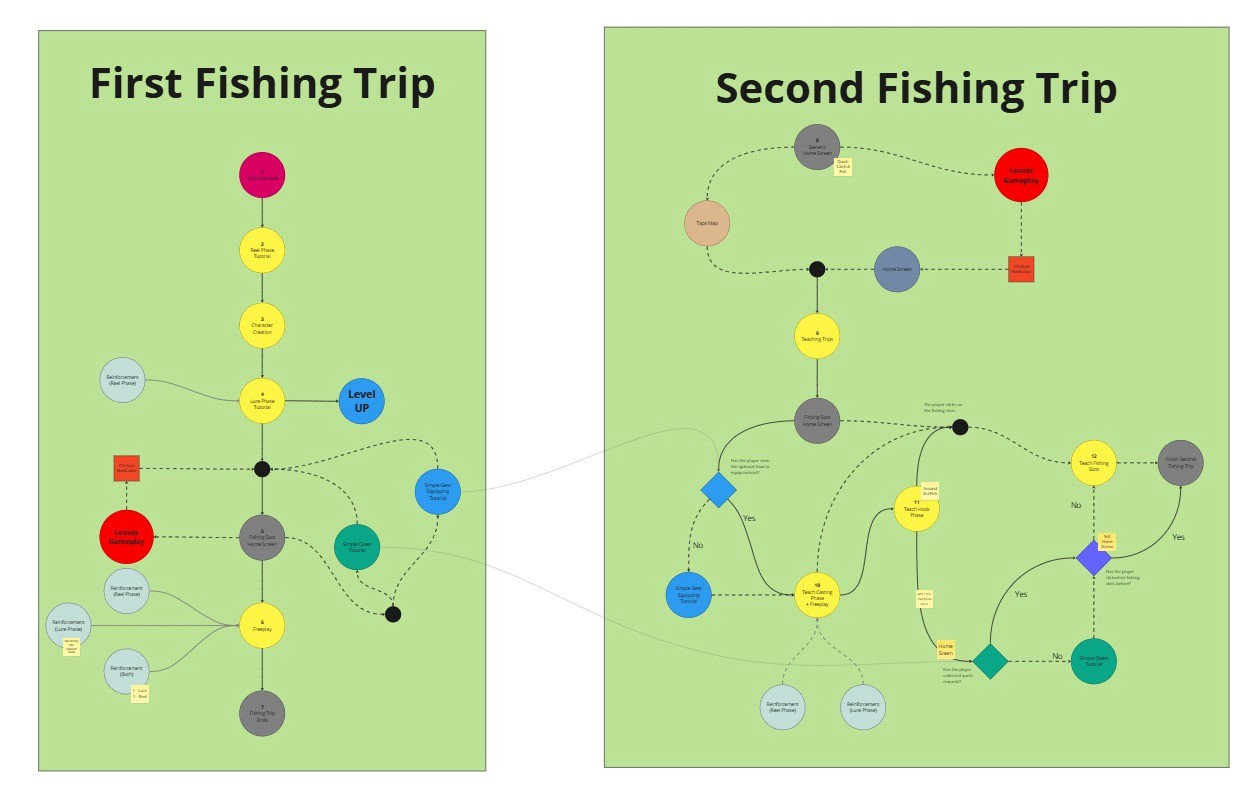
Basic recreation. Not actual guiding flowchart. Actual used materials are confidential and protected under NDA.
The Control Paradox
Reliance had a concern about the core gameplay. Internal testing suggested the dual-input mechanic — rod on X/Y axes, reel for tension management — was too complex for new players. They wanted to simplify it.
That wasn't a concession I was willing to make — I believed simplifying the mechanic would undermine the systemic foundation the rest of the game depended on. The dual-input mechanic wasn't just a feature — it was the foundation the entire game had been built from. The gear system was derived from the forces it put in the player's hands. The session structure existed to create planning around it. Simplifying the mechanic wouldn't have lowered the entry barrier — it would have invalidated everything built on top of it.
But the concern was legitimate. If players couldn't get through the first few minutes, the mechanic's depth didn't matter. It made a lot of sense from their perspective.
Two pushbacks arrived at the same time, with a short window to respond. The first was this: simplify the core mechanic. The second was a request to cut the narrative layer from the new FTUE design — the cutscenes and story moments I'd built into the first version of the redesign to ease players into the experience. I chose which fight to take.
I kept the mechanic intact and accepted the narrative cut. In exchange, I gave Reliance a mode split.
A simplified version of the gameplay automated half of the core mechanic — reducing input demands at the cost of a lower reward multiplier. And it worked simply by hiding the left controller and automating it's input to the best performance possible. The full mechanic remained available as an opt-in expert mode, with a higher reward multiplier. The framing was deliberate: player-facing, simple mode showed 1x rewards and expert mode showed 1.2x. The actual split was 0.8x and 1.0x internally — but what players saw was an upgrade path, not a difficulty warning. The FTUE introduced the simplified mode first, then surfaced the expert mode as something to unlock. Players who wanted more control had a clear reason to reach for it. Players who didn't were still playing the game.
This preserved the core mechanic, addressed Reliance's concern, and created a natural mastery curve inside the onboarding itself. New players could engage immediately without facing the full system's demands — and the full mechanic remained intact for players who sought mastery. Accessibility and depth without fragmenting the core.
The narrative cut was the right call given the constraints. Mobile players rarely engage actively with story in the first session — mechanical discovery does more work than narrative in that context. And the mode split was something a programmer could implement quickly without dependency on the art team. The narrative version required assets we didn't have the bandwidth to produce on Reliance's timeline. I'd have wanted to A/B test it anyway — my hypothesis was stronger early engagement, but it's a hypothesis I couldn't prove.
Designing for Mobile Sessions
Mobile sessions end unexpectedly. A player might put their phone down at any point.
The Forced Flow accounted for this with a branching behavior at the end of the first fishing trip. When the player returns to the home screen and receives a new quest, the flow splits based on what actually happens next: if they leave the game, they receive a push notification and re-enter at an equivalent point. If they keep playing, they proceed directly. The content is the same — the entry point adapts to where the player actually is.
This wasn't about encouraging short sessions. It was about not punishing them. A player who leaves and comes back shouldn't feel like they missed something or need to restart. The flow accommodates reality instead of assuming ideal behavior.
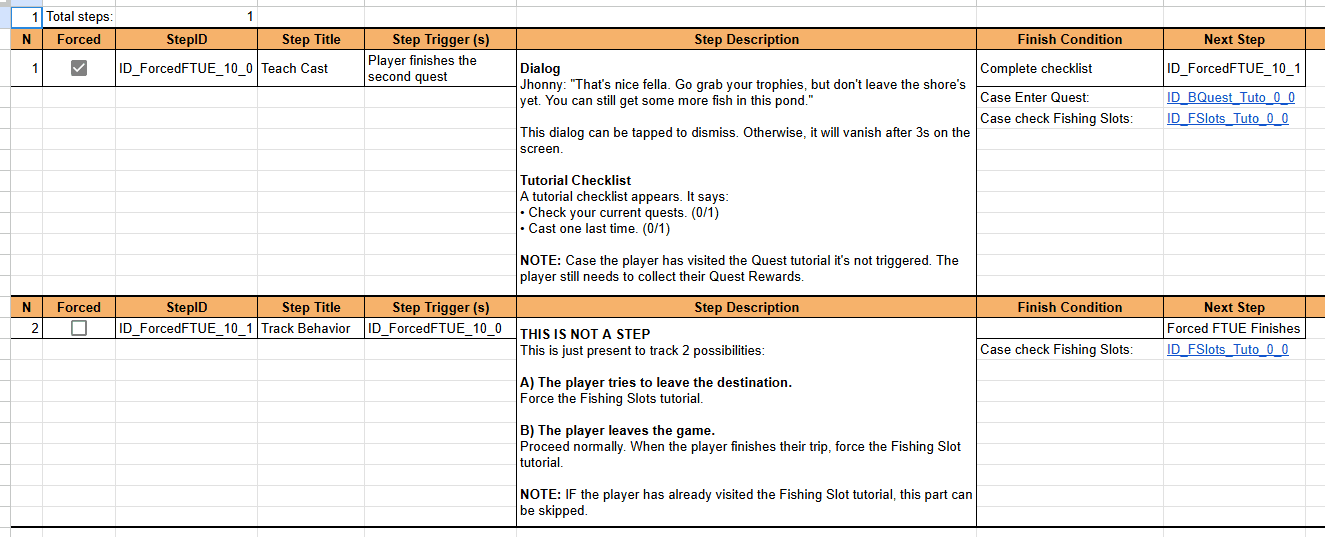
Not actual spreadhseet used for implementation. This is a model to illustrate the article. Actual used implementation materials are confidential and protected under NDA.
Using the Systems in our Favor
Differently from the first iteration made for a rushed soft launch, the redesigned FTUE wasn't built in isolation. It relied on several systems already in the game — and was designed to expand all of them beyond onboarding.
The Quest System was the structural backbone. Even without a full campaign implemented, the Main Campaign quest line served as the guide for unlocking fishing spots — giving players a reason to progress that was legible, trackable, and reward-driven from the first session onward. The Glossary provided contextual definitions surfaced inline, so players could look up terms without leaving the flow. Tutorial Pop-ups and Hint Pop-ups handled the moment-to-moment guidance in both the Forced and Contextual layers. The Timer system governed time-constrained steps.
Critically, none of these were built for the FTUE alone. Each was specified to be expandable across the full game. The tutorial infrastructure was game-wide tooling that happened to be used most heavily in the first session. By building the FTUE on top of existing systems rather than alongside them, onboarding became part of the game's systemic architecture — not a separate layer to maintain independently as the game evolved.
What Shipped
FTUE completion before the redesign sat at 14% — real data from a soft launch that had expanded to more markets without a corresponding increase in targeted UA. The baseline reflected a broader audience than the initial batch, arriving with less intent.
After the redesign launched, the 23% figure came to me informally from a colleague, about a week after the update went live and roughly three weeks after I left Reliance. It's the only real data point I have for the new flow, and it was early — one week post-launch isn't a readout, it's a directional signal. The Forced Flow funnel was tracked node by node, so Reliance had visibility into exactly where players were dropping off. What I can say is that the signal was moving in the right direction. Whether it held, I don't know.
What I do know is what changed structurally. FTUEs built before core systems are finalized tend to require repeated rework as the game evolves — each update risks breaking a tutorial built on assumptions that no longer hold. This version was built on the actual systems, which meant it aligned with the game as it functioned rather than as it had been planned. That eliminated the engineering overhead of the previous flow and removed the disconnect between what players were taught and what they encountered when they played.
The Contextual layer ran quietly in the background, surfacing guidance when players needed it and staying out of the way when they didn't. The expert mode adoption rate is something I'd have wanted to track closely — understanding how many players made the transition from simplified to full controls would have been the most meaningful signal about the mastery curve. That data wasn't available to me before I left.
Rapala Fishing (formerly: Rapala Fishing: World Tour) — Senior Game Designer (Reliance Games) · 2023–2024