Ten Days to Scream
Constraint-Driven Design in The Suicide of Mr. Tanaka
Context
In 2020, I was frustrated. It was the middle of the pandemic, the course I taught Game Design at had cancelled my classes. I had been designing games for years — systems, quests, mechanics — but always inside someone else's project, as a freelancer, always with a team around me, always with someone pointing at me. I hadn't proven to myself that I could make a game alone, from nothing, and have it be something.
The Scream Lite Game Jam gave me a window: ten days, a theme — Profit and Corporations — and a genre expectation of horror. I decided to go alone, and I decided to prove something.
What came out was The Suicide of Mr. Tanaka: a mystery point-and-click adventure set in Osaka, built around the Japanese phenomenon of karōshi — death by overwork — filtered through the cosmic horror register of Kult: Divinity Lost. #1 Host Choice of the jam. #11 Best Game by community vote.
This is the story of how a set of hard constraints produced better design decisions than I would have made with more time and more resources.
The Constraints
I had ten days. I was the only person on the project. I am not a visual artist - not by far. I had limited time for sound design, but I am a bassist and I have always cared about music.
Each of those constraints shaped a decision. None of the decisions were compromises.
Title Screen
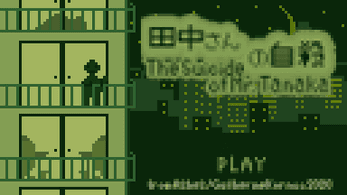
The Title Screen Was the First Scene
Most games treat the title screen as infrastructure: logo, menu, press start. A container before the experience begins.
In Mr. Tanaka, I collapsed that container entirely.
The title screen is the opening scene. The player sees a rooftop at night, a figure standing at the edge. They press Play. Tanaka jumps. Fade to black. The sound of a lighter clicking once. The game begins — and the player is already a witness to the crime they're about to investigate.
The player's first interaction with the game is also the inciting incident. There is no separation between "entering" the experience and "being in" it. That compression is what the judge baasket was responding to when he wrote that the game had hooked him "after just ten seconds of gameplay" — and it cost nothing to implement. No cutscene budget, no voice acting, no elaborate animation. Just a deliberate decision about what the first click should mean.
This was a constraint solution. I had no time to build a proper opening sequence. What I had was a title screen I had to build anyway. The decision was to make those two things the same thing.
Silence as a Design Decision
I am a bassist. Music matters to me. I also had ten days and no sound designer.
The obvious move was to find royalty-free ambient tracks, scatter them across the game, and call it done. I didn't do that.
I composed one piece of music for the whole game: a bass leading opening theme that also dubbed as an ending theme. Heavy. Unsettling. Slow. Aside from that, there's a single click of a lighter as the playable part opens, and then the game is radio silence. No ambient loops. No UI sounds. No environmental audio.
That silence was originally a constraint: I didn't have time to do sound design properly, so I chose not to do it at all. But silence in a horror-adjacent game isn't neutral — it's active. It creates a specific kind of dread, the kind that comes from the absence of information rather than its presence. The player can't use ambient sound to orient themselves or anticipate what's coming. The world feels wrong in a way that's harder to articulate than a jump scare.
There is one moment of sound in the game's interior: a single scream — at the only jump scare in the game, near the end. And that's also the only moment where the collor pallet shifts (more on this down bellow).
That sound works because of everything that preceded it. If the game had ambient audio throughout, the scream would have been one sound among many. Because the game is silent, the scream is the only unexpected sound the player has ever heard. The constraint that created the silence is also what makes that single moment land.
A Honest Art Direction
As I already said, I am not a visual artist. I can't paint, I can't draw convincingly in a realistic style, and I had no collaborators.
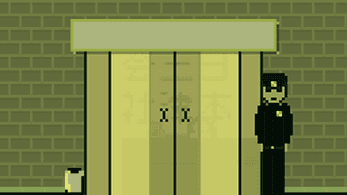
The solution was the Game Boy palette: four shades, black and green, the visual language of an era defined by constraint. The choice was honest — I chose a style I could execute well over a style I couldn't execute at all — but it became something more than a workaround. Players responded to it specifically. One reviewer called the art "vibrant Game Boy style graphics." Another praised the visual tone before anything else.
The palette also solved a consistency problem I didn't have to solve consciously: with four colors available, every visual decision I made automatically fit with every other one. There was no way to produce elements that clashed. The constraint enforced coherence that I couldn't have enforced through taste alone in ten days.
The only change - purposedfuly - was the jump scare. In that specific scene, the game shifts to black and red.
Then it's back to the green-ish dark atmosphere.
Snippet of the "game boy pallet".
Narrative Structure Without a Budget
The jam theme was Profit and Corporations. The genre expectation was horror. My reference points were karōshi journalism, Japanese corporate culture, and Kult: Divinity Lost — a tabletop RPG built around the idea that reality is a cage and something terrible is waiting outside it.
I didn't have time to write a long game. What I had time for was the shape of a mystery: a question asked in the first ten seconds, an investigation, and a revelation.
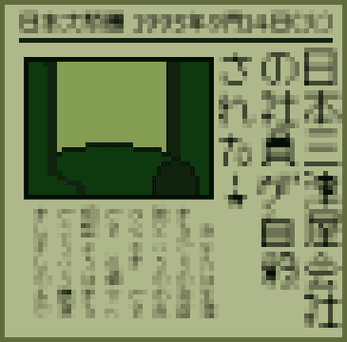
The investigation is told through multiple formats: newspaper clippings that reveal the facts of Tanaka's death, environmental exploration across Osaka's districts, and a key dialogue encounter with an informant. The informant scene is the emotional center of the game — a long exchange that requires the player to pay attention, because what they learn there recontextualizes everything that came before.
The reviewer from SCREAM CATALOGUE identified what that structure was doing: "the mystery gradually unfolds through a series of clippings of text, and the encounter with the informant that creates a palpable sense of dread." That pacing — measured revelation, environmental texture, a single moment of confrontation — was not the product of an elaborate writing process. It was the product of understanding what a mystery needs structurally and building exactly that, with no room for anything extra.
Two small puzzles punctuate the pacing. They exist not because the game needed puzzles, but because a mystery without something to solve isn't a mystery — it's a story. The puzzles are simple. They're also exactly the right weight for a ten-day game.
Newspaper clipping. Of course there was English text in the UI.
What Shipped
The Suicide of Mr. Tanaka placed #1 Host Choice and #11 Best Game out of the full jam field, built by one person in ten days with no art background, no sound team, and Construct 3 as the engine.
The constraints produced better work than more resources would have. Not because constraints are inherently good, but because each one forced a decision — and in every case, the decision that resolved the constraint also resolved a design problem I didn't know I had.
The title screen that had to double as an opening scene became the game's strongest hook. The silence that existed because there was no time to fill it became the architecture that made the one sound in the game meaningful. The palette that existed because I couldn't draw became the visual identity that reviewers specifically praised.
The game is unfinished. The music isn't fully implemented, some UX issues shipped, and there's only one ending when there could be more. Players who finished it wanted more of it.
That last part is the one I'm most proud of.
The Suicide of Mr. Tanaka — Solo Developer — Scream Lite Game Jam · 2020
Playable in browser: gkorn.itch.io/the-suicide-of-mrtanaka