The Tradeoff of a Generation
Genre Expectations and Camera Design in God of War (2018) - A Tradeoff Analysis
The Genre
Hack'n'slash is built around spatial awareness. From the genre's earliest entries, the fantasy has been consistent: you are surrounded, outnumbered, and fundamentally more dangerous than everything in the room. Executing that fantasy well requires the player to read the room — to see where enemies are, how they're positioned, and how to respond. The camera is the primary tool for delivering that information.
God of War originated as a hack'n'slash. Since the PS2 original — which I finished — the franchise was built on that fantasy: overwhelming force, aggressive combat, a protagonist who dominates crowds. I played the 2018 entry and Ragnarök at launch. They are great games, and the reboot's creative direction — heavier tone, narrative weight, intimate cinematography — is a legitimate and commercially successful evolution.
This is an analysis of a specific tension that evolution created, and how I would have resolved it differently. This isn't a proposal to modify the shipped game — it's a design perspective: given the same goals and constraints, how I would have approached the problem from the start.
The Tension
The 2018 entry's continuous shot — no cuts from opening to credits — is a genuine cinematic achievement. The over-the-shoulder camera serves exploration, narrative, and the emotional register of the game beautifully. It is also, in combat, one of the most intimate cameras in the hack'n'slash genre.
That intimacy creates a tension with genre conventions. Hack'n'slash combat asks players to manage multiple simultaneous threats. Managing threats requires seeing them. The 2018 camera's field of view makes a meaningful portion of the combat space invisible at any given moment.
The design team solved this — elegantly, and at cost. As documented in their GDC postmortem, they spent a year on combat, and one of their central challenges was precisely this: enemies outside the player's field of vision felt unfair. Their solution was to have enemies advance and retreat in turns, keeping the active threat within the camera's view. It works. It gives the combat rhythm and readability.
It also redefines what hack'n'slash means in this game. The simultaneous threat management that characterizes the genre becomes sequential. The spatial reading that the fantasy depends on is replaced by a more curated, reactive loop. These are defensible choices — but they are departures from genre convention that I felt across two full playthroughs.
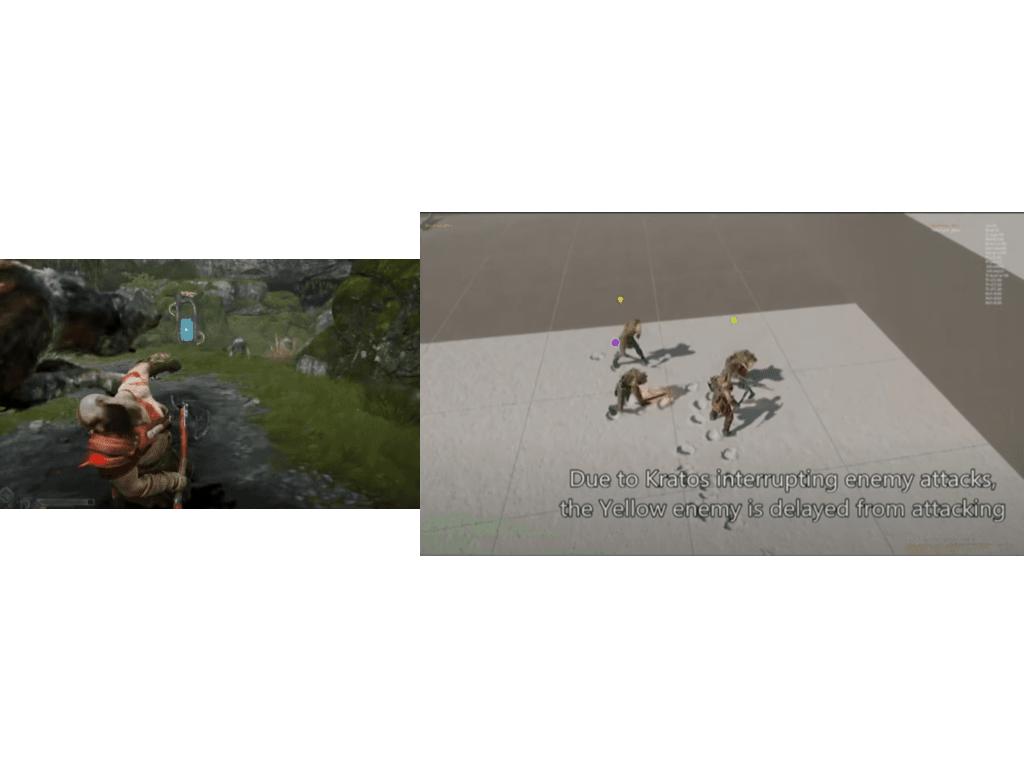
The only two images submitted for this piece on the test. On the left, Kratos being surprised by a wolf attacking from the side (something that wouldn't happen with spatial awareness). On the right, a very extreme pullback in editor/playtest mode.
The Proposal
A context-sensitive camera pull-back, designed in from the start.
The intimate over-the-shoulder framing stays for exploration, narrative, and everything outside of combat. When enemies are detected and a fight begins, the camera widens its field of view — pulling back enough for the player to read the space around them. The continuous shot survives: no editorial cut, no break in the illusion. What changes is FOV and distance, not the filmmaking constraint the creative direction was protecting.
This is worth being precise about. The proposal isn't to retrofit the existing game — the last thing I'd touch on a shipped title built around its camera is the camera. What I'm describing is a foundational decision: if I were on the project from the start, I would have built the game with this camera. Enemy placement, encounter design, AI behavior, animation — all of it would have been developed with the pull-back in mind, not adapted to it after the fact.
The transition exists in the developmental record: a pull-back variant was tested internally during production. Creative direction chose to sustain the intimacy. I would have argued the other way, earlier.
Batman: Arkham demonstrates that this transition can work cleanly when built into the game's foundation — close during exploration, generous during combat, intimate again when the fight ends. The games are not comparable in tone or genre philosophy, but the camera problem is the same, and the solution is proven.
What Changes
With expanded spatial awareness built into the foundation, enemy design has more room from day one. Enemies can be designed to circle, flank, and pressure simultaneously rather than in turns — because the camera assumes the player can see them. Encounter design can ask more of the player's spatial reasoning, which is historically what the franchise asked. The fantasy of dominant-but-surrounded has more mechanical space to live in.
A wider combat frame would allow encounters where ranged enemies pressure from distance while melee enemies flank simultaneously — forcing target prioritization rather than reaction to sequential turns.
What would be lost is also real: some of the combat's deliberate pacing, some of its cinematic rhythm. That's the tradeoff. I find the genre conventions more important to preserve than the intimacy in combat specifically — but I recognize that's a creative position, not an objective correction.
Production Consideration
Camera decisions made at the start of production propagate through everything built afterward. That's precisely why this argument has to be made early — and why it would be the wrong argument to make on a shipped game.
In a project built with the pull-back from the beginning, encounter design assumes the player has spatial awareness. Enemy AI can be tuned for simultaneous pressure rather than sequential turns. Animation budgets for enemies can account for being read from a wider frame. None of this is free — wider spatial awareness means more enemies need readable silhouettes, clearer telegraphing, and more deliberate placement. The camera doesn't simplify encounter design; it changes what encounter design has to solve for.
The continuous shot constraint is also more permissive than it sounds. If "no cuts" means no editorial cuts between gameplay and cinematics, a FOV and distance shift during combat doesn't violate it — the camera is still one unbroken perspective. The cutscenes in the shipped game already move the camera independently of the gameplay frame. The constraint was always about editing rhythm, not about keeping the camera fixed.
The tradeoff the creative direction made is coherent. The intimacy they preserved serves the narrative and the tone in ways that are genuinely hard to replicate. I'd have made a different call — but I'd have made it at the beginning, when the game could be designed around it.
Game Designer Position — Technical Evaluation — 2022 · Question: "Name a game you consider to have bad 3Cs and explain why. Design one change that helps the issues and explain its larger impact on the game."