It Wasn't About Getting to the Destination
Designing a Grappling Hook for Assassin's Creed's Open World RPG Era
Context
Assassin's Creed's traversal used to have soul.
Not because it was realistic, or because it was the most technically impressive movement system of its era. But because it had friction — the interesting kind. Moving through a city required reading it. You identified a route, evaluated whether it was scalable, found the path that worked. The parkour system rewarded players who understood their environment and punished those who didn't. Traversal was a skill, and getting good at it felt like something.
The open world RPG entries — Origins, Odyssey, Valhalla (at the point of writing this originally) — made a different choice. The worlds got larger, mounts got more common (almost mandatory), ships or boats arrived, and traversal was utterly simplified. Climbing became nearly universal. Routes stopped mattering. The game would get you there. What was once a system with its own logic, and a fun experience for players, became a means to an end: you go from A to B. The journey between them is rarely interesting.
This isn't a failure, let's state it openly. It's a tradeoff the series made deliberately, and the combat and narrative systems that benefited from it are excellent. But it left a gap.
Traversal in these games has no texture.
The grappling hook is not a fix for what was lost. It's an addition that makes sense within the philosophy the games already chose — and adds a layer of interaction to a system that currently has almost none.
The Tool
A grappling hook, acquired mid-game as a tool upgrade. Not automatic — contextual, requiring deliberate input from the player, closer in feel to Far Cry 6's implementation than to Syndicate's Batman-adjacent rope launcher.
The hook has three functions, each derived from a different use case.
Vertical traversal. The hook can be fired at a surface above the player, allowing them to pull themselves up quickly — bypassing the standard climbing animation on surfaces that would otherwise require a long, uninteresting ascent. It can also be used to descend controlled — a context-sensitive input when near a ledge deploys the rope and lowers the player rather than dropping them.
Ziplines. Two anchor points in the environment can be connected with a rope, creating a one-way zipline between them. The player sets the first anchor, moves to the second position, and sets the second. Direction is determined by elevation — the zipline runs downward from wherever it was set. These are temporary, player-constructed, and don't persist between sessions.
Bungee descent. A context-sensitive input when falling from significant height deploys the hook into a nearby surface, converting a fatal drop into a controlled swing. This is a deliberate player action, not an automatic safety net — a player in freefall has a window to trigger it. Missing the window means hitting the ground.
The hook can also be fired via a dedicated ammunition type — equipped the way a player would equip fire or poison arrows, fired through the existing bow system. The behavior at impact is different from any other projectile in the game: it anchors rather than damages, and what follows is a traversal interaction, not a combat one.
The grappling hook is intentionally scoped as a feature, not a systemic traversal overhaul. Its goal isn't to redefine how players move through the world — it's to introduce targeted interaction points within an otherwise low-friction traversal model. That scope is a design choice, not a limitation.
Images submitted with the original test.
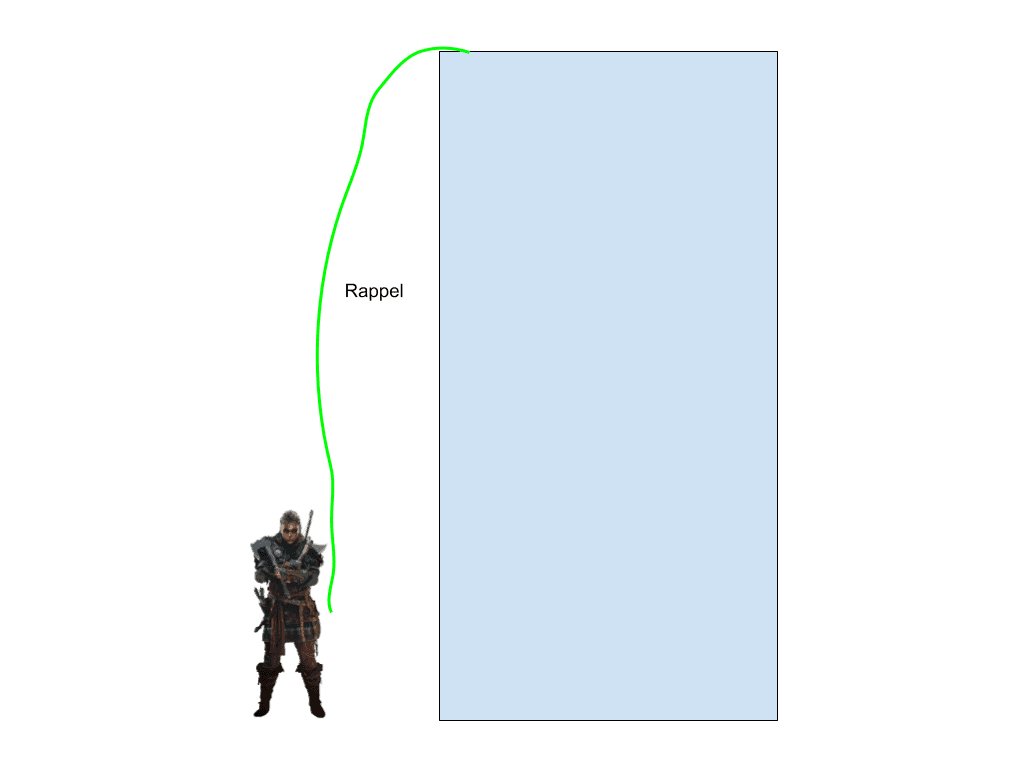
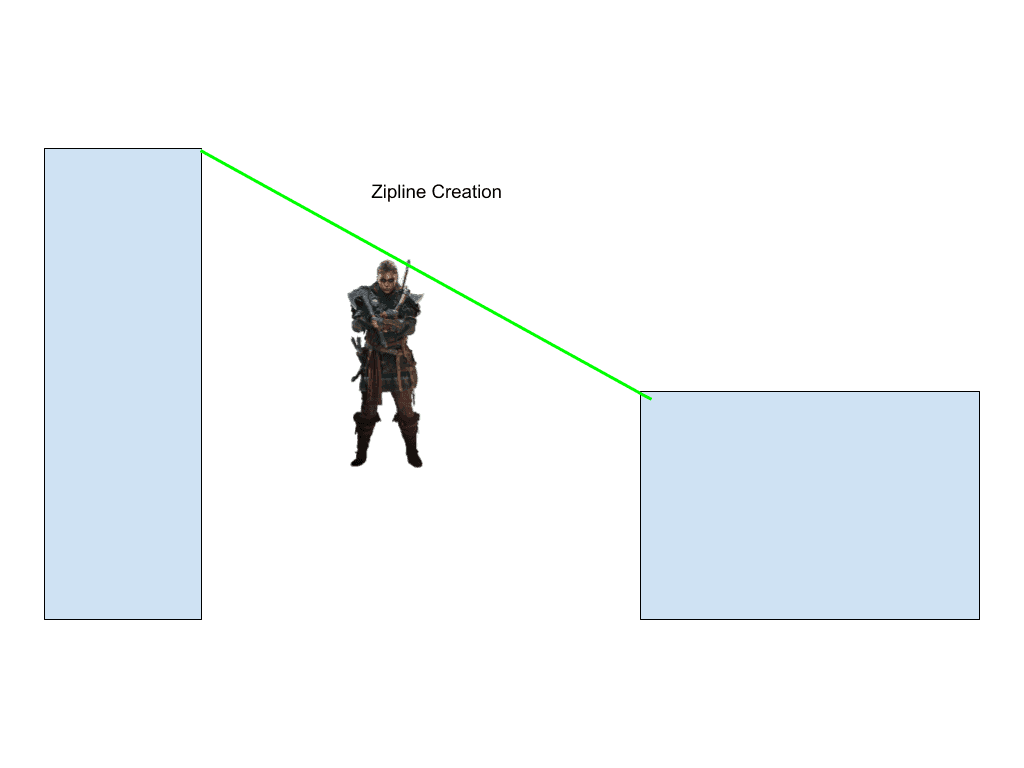
Impacts for the Mechanics and the Players
The most direct impact is on verticality. The open world RPG entries have large structures — fortresses, cliffs, temple complexes — that currently exist as obstacles to navigate around or slowly climb. The grappling hook converts these into tools. A fortress wall stops being something you circle looking for the climbable section. It becomes a surface you read differently — where's the best anchor point, what's on the other side of that parapet, can I set a zipline to that tower.
The bungee descent changes how the player thinks about height. In the current games, falling from significant elevation is a consequence to avoid. With the hook, elevation becomes a resource — a position to exploit, a means of fast descent, an escape route that wasn't available before. A player being pursued through a city now has the option of going over the edge of something tall, rather than fighting through the street level.
Neither of these returns traversal to what it was in the earlier entries. That's not the goal. The open world RPG games are built around a different contract with the player — one that prioritizes scale and freedom over precision and friction. The grappling hook operates within that contract. It adds a decision layer to traversal that currently has almost none, without requiring the level of precision the earlier system demanded.
Getting there becomes, occasionally, interesting again.
Production Considerations
The three functions of the hook carry different production costs, and it's worth being specific about each.
Ziplines are the most open-ended — and therefore the most dangerous from a world-building perspective. A player-constructed rope between two anchor points sounds simple until the open world has to account for every surface they might try to use. The solution is to not let them persist: the zipline exists for the duration of the traversal, then disappears. That single constraint removes the problem of the game having to track and render indefinite player-placed geometry, and keeps the tool feeling deliberate rather than exploitable.
The bungee descent has a calibration problem. The window for triggering it during a fall needs to be wide enough to feel fair but narrow enough to feel like a skill — and the player needs to know they're in that window without a UI element breaking the moment. The AC camera, being third-person and sufficiently pulled back, gives the player enough visual context to read their height, which helps. The real work is in feedback design: a subtle audio or visual cue that communicates "the hook is ready" without announcing it.
The hook-via-arrow is best treated as a special ammunition type rather than a separate input — the player equips it the way they'd equip fire arrows or poison arrows, and fires it through the existing bow system. The behavior at impact is where the pipeline complexity lives: animation, VFX, and UX all need to recognize that this projectile anchors rather than damages, and that what follows is a traversal interaction, not a combat one. That's a sync problem between teams, not a system problem — but it's a real one, and it needs to be flagged early.
Even as a feature, the hook intersects with authored traversal and encounter design. Assassin's Creed's restricted areas are built with implicit assumptions: intended entry points, climb paths, patrol coverage tuned to expected approach angles. A player with a grappling hook can bypass those assumptions — not by breaking the game, but by approaching from angles the level wasn't designed to account for. The goal isn't to prevent that. It's to ensure environments remain legible and functional when they do. Surfaces that accept anchors, sightlines from elevated positions, and enemy placement all need to be designed with the hook in mind — not retrofitted around it.
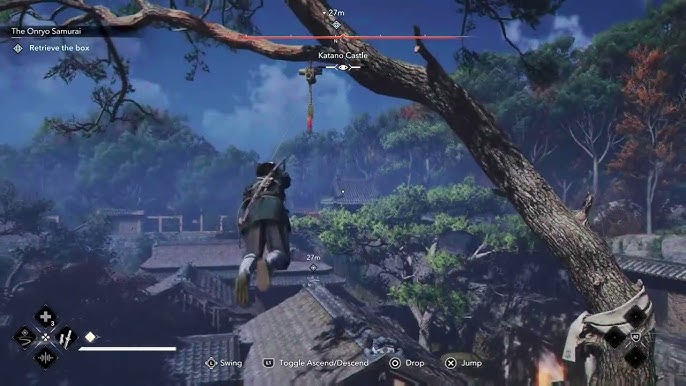
Naoe's grappling hook in AC Shadows. I do not claim authorship, but it felt good to see that my solution was similar to something the team at Ubisoft was designing, as it validates my approach.
What Was Proven
This proposal was not designed by me in production. What it did was converge with a solution that later franchise entries explored in similar directions, which suggests the problem space was real and the proposed direction was aligned with where the series’ stealth design eventually moved. The grappling hook in that game functions through contextual input, attaches to designated points across the environment to facilitate climbing, and creates traversal options that the base movement system doesn't support alone. The bungee descent mechanic — using the hook to convert a fall into a controlled movement — did not ship in the same form.
I'm not claiming authorship. Design spaces are consistent enough that multiple designers working on the same problem often arrive at similar solutions. What I can say is that the gap I identified was real, the direction I proposed was viable, and the franchise moved in that direction.
Game Designer Position — Technical Evaluation — 2022 · Question: "Name a game you consider to have good traversal and explain why. In the same game, design one additional skill or tool that would increase the character's navigational possibilities and define its larger impact on the game."