The Blade in the Crowd
Analyzing and Extending the Stealth System in Assassin's Creed Odyssey
Context
Assassin's Creed was built on three pillars: assassination, traversal, and combat. Not equally — in the entries most defined by the original assassin fantasy, the first two defined the experience and combat was the consequence of getting them wrong. You moved through crowds unseen, you positioned yourself above your target, you struck and disappeared. The fantasy wasn't being a warrior. It was being a predator.
Odyssey is a great game. It's also the point where the series fully committed to being an action RPG — massive open world, narrative choices, deep and satisfying combat systems. That's a deliberate direction, and it works on its own terms.
But it came at a cost. Traversal became getting from A to B. And stealth became crouching in tall grass.
I have two hundred hours in Odyssey — I love the game. I still think its stealth system is too shallow to deliver the fantasy the franchise was built on. That gap is what this analysis is about.
The System
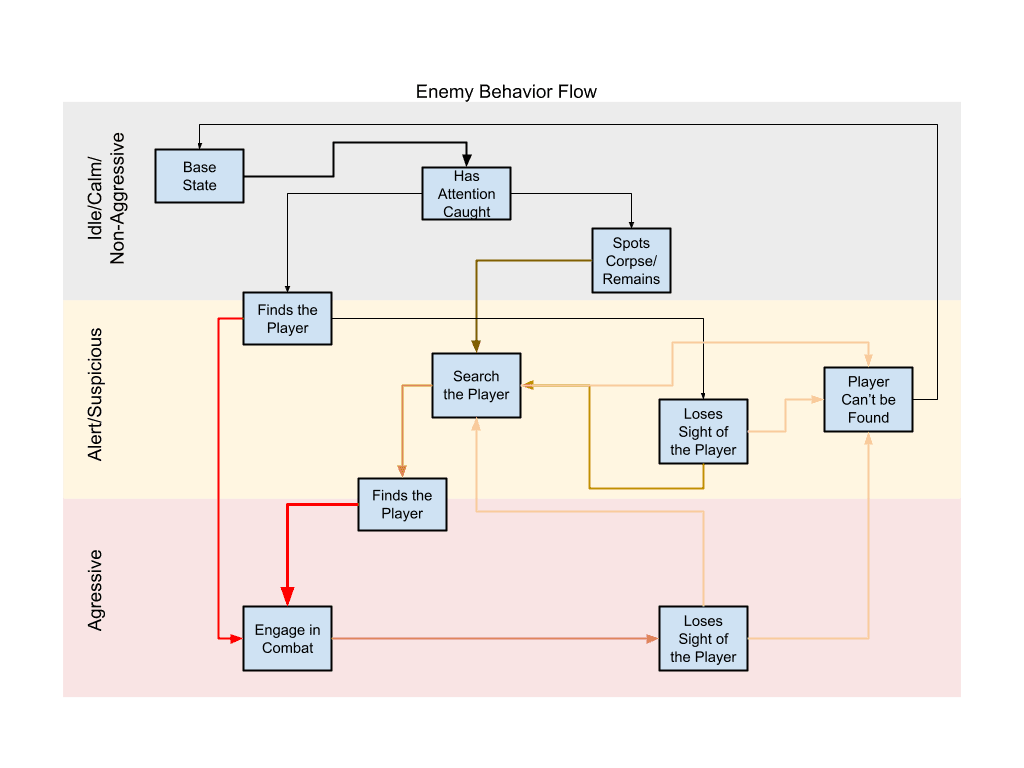
Odyssey's stealth system reacts to player actions through a detection model built on visibility and proximity. Enemies have a perception arc — enter it while crouching and out of their sightline, and you're undetected. Alert them and they enter a search state. Lose them and, after a short timer, they return to normal.
The system is functional. It's also binary in a way that works against the fantasy.
Strengths
The detection model is readable. Players understand the rules quickly — crouch, stay out of sightlines, use cover. The system doesn't punish experimentation harshly, which fits a game that wants players to feel powerful.
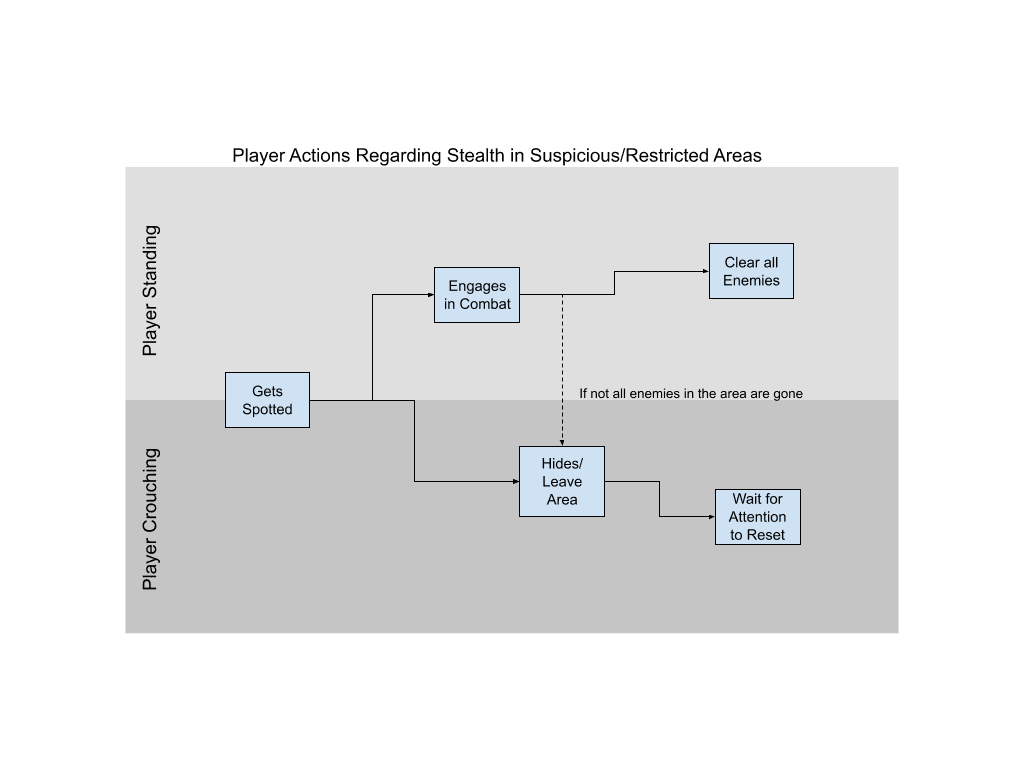
Restricted areas create stealth opportunities even in a game that doesn't require stealth. Players who want to engage with it have space to do so.
Weaknesses
The search state is shallow. When an enemy loses sight of the player, they search briefly at the last known position and then return to normal — as if nothing happened. There's no memory, no escalation, no consequence for being partially detected. The world forgets.
The system doesn't encourage stealth — it permits it. There's no mechanical depth that rewards patience, planning, or reading enemy behavior. A player who engages the stealth system gets roughly the same outcome as one who ignores it and fights through. The system has no teeth in either direction.
For a franchise built on the fantasy of the invisible assassin, that's a structural problem.
Images from the submitted test. AC Odyssey's system analysis.
The Proposal
Two alterations, designed to add depth without adding complexity — and to serve the fantasy rather than fight it.
Post-Image
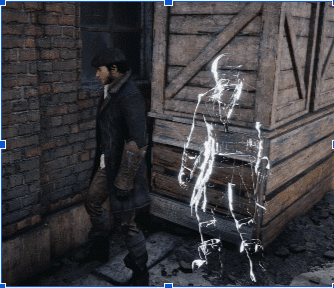
When an enemy loses direct sight of the player, the last confirmed position is marked — visible to the enemy as a behavioral target, not as a UI element. The enemy moves to that position and searches from there, rather than searching loosely in the area. The mechanic isn't new to the franchise — Assassin's Creed Syndicate used a version of it. The proposal here is extending it to Odyssey, where it was absent.
This does two things. It makes enemy search behavior legible and predictable — players can read where enemies will go and plan around it. And it creates a skill layer: the player who understands the Post-Image can use it, placing themselves somewhere visible long enough to draw enemies away from where they actually want to be.
It also closes the loop on partial detection. Being seen briefly now has a consequence: an enemy moving toward where you were, with purpose. The world doesn't forget anymore.
Image from Assassin's Creed Syndicate's post image feature, also submitted as an example in the test.
Aware and Nervous States
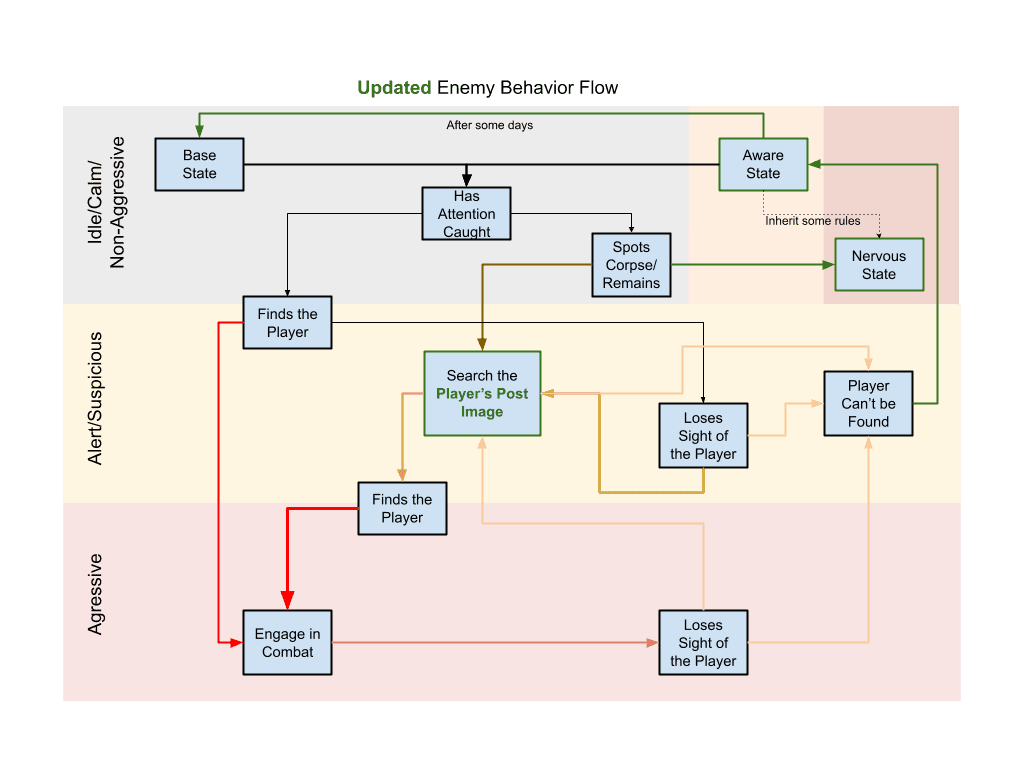
The current system has two states that matter: undetected and searching. The proposal adds two intermediate states that create a more granular — and more threatening — middle ground.
Aware is the state an enemy enters after something breaks the pattern without confirming the player's presence. A sound. A body discovered. An ally who hasn't reported in. In Aware, the enemy's detection fills faster and their attention threshold is permanently elevated — they don't return to full passivity. They remain watchful.
Nervous is triggered by direct evidence of the player's presence without visual confirmation: a discovered body, a suspicious noise, a Post-Image that led nowhere. In Nervous, enemies change their behavior structurally — they move in pairs, they stay alert longer, they gravitate toward points of interest. And Nervousness is contagious: an enemy in contact with a Nervous ally becomes Nervous too, spreading the state through the patrol without the player needing to trigger each one individually.
Both states clear after significant in-world time — not minutes, but long enough that a player who stirred up a compound and retreated can't simply wait thirty seconds and walk back in.
Together, the two states transform the stealth system from a binary — seen or unseen — into a gradient. Partial detection has consequences. The world builds a picture of the player's presence even without confirming it. And the player who reads that picture and responds to it is playing the game at a level the current system doesn't support.
Image from the submitted test. Updated system.
What This Delivers — And What It Doesn't
None of this makes Odyssey a stealth game. That's not the goal and it shouldn't be.
What it does is give the fantasy somewhere to live. The player who wants to move through a compound unseen, position themselves, and strike at the right moment now has a system that rewards that approach — that makes the reading of enemy behavior meaningful, that creates tension in partial detection, that punishes carelessness without removing agency.
One clarification worth making explicit: this doesn't need to make baseline stealth harder. The starting state — undetected — and the ending state — full combat — remain the same. What changes is the space between them. A player who trips a state and chooses to push through still can. A player who reads the system and adapts has more tools to do so. The pacing slows only if the player wants it to. Everything else in the game functions identically.
The blade in the crowd needs a crowd worth hiding in.
Production and Development Considerations
None of these proposals are free to implement — and the interesting production problems aren't in the states themselves, they're in the parameters that govern them.
The Nervous contagion radius is the most sensitive variable. Odyssey's encounter density varies wildly: a fortress has twenty guards in a confined space, a roadside camp has four spread across open terrain. A contagion radius tuned for one breaks the other — either spreading too slowly to matter in open encounters, or cascading uncontrollably in tight ones. The fix is to expose the radius as a tunable parameter per encounter type, not a global value, and give level designers the tools to validate contagion behavior per location before it ships.
State duration has a similar problem, but the solution is already in the game's architecture. Odyssey tracks quest context — whether a location is an active objective or ambient world. Nervous and Aware states clearing faster in ambient locations and persisting longer during active quests isn't just a design improvement, it's a legibility improvement: the world behaves more seriously when the player is supposed to take it seriously.
The Post-Image faces a different challenge — legibility in open environments. In a fortress, a guard moving purposefully toward where you were is readable. In open terrain, that same behavior can read as aimless. Shadows shipped a version of this system, and the solution there leaned on particle effects, lighting cues, and onboarding to teach players what they were seeing. The pattern works. The feedback layer around it has to be designed as carefully as the system itself.
What Was Proven
These proposals were not designed by me in production.
What they did was converge — partially and independently — with solutions that later franchise entries explored in similar directions, which suggests the problem space was real and the proposed direction was aligned with where the series’ stealth design eventually moved. Post-Image behavior, where enemies move to and search from a player's last confirmed position, shipped in recognizable form. The multi-state detection system — intermediate states between undetected and full alert, with enemies communicating and moving together in response — also shipped in a form close to what was proposed here.
I'm not claiming authorship. Design spaces are consistent enough that multiple designers, working on the same problem, often arrive at similar solutions. What I can say is that the problem I identified was real, the direction I proposed was viable, and the franchise moved in that direction.
Game Designer Position — Technical Evaluation — 2022 · Question: "Choose an existing game with a policing system (system that reacts to specific player actions and offers consequences). Analyze the system's levers and place within the full experience. Identify the design's strengths and weaknesses and suggest an alteration that would impact the game positively. Explain your process and expected results."